What cybersecurity AI can actually do, and what it can’t

TL;DR
- AI amplifies whatever you point it at. Clean data wins; messy data fails faster.
- It compresses detection and triage, but can’t replace human judgment.
- Attackers use AI too, so it won’t permanently close the gap.
- What separates good tools from bad: data quality, explainability, human oversight.
Vendors say AI will solve your security problems. Attackers are already using it against you. Both claims hold up. The full picture just requires more precision than most vendor decks bother with. Before your team commits a budget to another AI security tool, this breakdown covers what delivers, where it breaks, and what that means for teams running lean.
AI is a capability multiplier. Clean data, strong analyst workflows, and clear escalation paths get amplified, and so do incomplete logs, misconfigured sources, and broken processes. If your security data is a mess, AI only helps you fail faster with better-looking dashboards.
The adoption numbers back up the urgency. ISC2’s 2025 Cybersecurity Workforce Study puts 69% of organizations on a path toward regular AI tool use, with 28% reporting active integration into their operations. How many of those deployments are producing measurable outcomes versus collecting dust as impressive POCs?
Where AI genuinely excels in cybersecurity
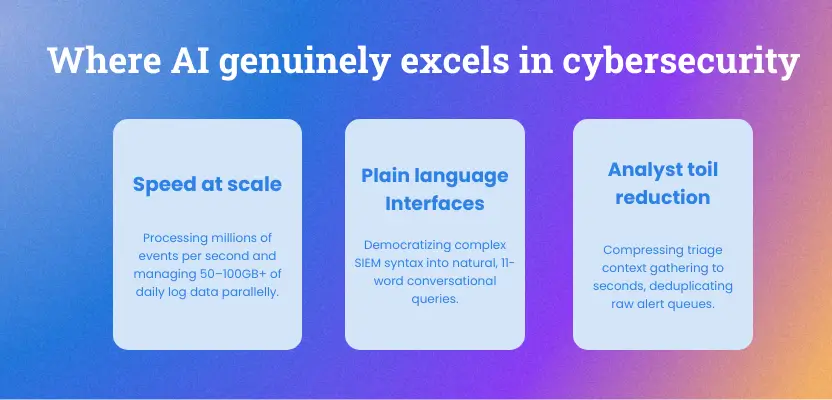
There are three main areas where AI delivers real, measurable value for security teams: Processing data at speeds no human analyst can match; Providing plain-language interfaces that open security tooling to non-specialists; And cutting the analyst toil that drains capacity even on experienced teams.
These aren’t soft wins. Each has a documented, quantifiable impact, and each matters differently depending on the size and structure of your team. A two-person security function covering a hybrid environment gets a different return from AI-assisted triage than a 15-person SOC does, and understanding which capability matches which constraint is the practical work before any purchase decision. The sub-sections below go specific.
Speed at scale: processing what humans cannot
AI-driven detection systems correlate millions of events per second across every asset in scope simultaneously, a performance gap over manual review that is not marginal. Mid-size enterprise environments commonly generate tens of gigabytes of log data per day, with centralized logging deployments often handling 50–100GB+ daily depending on telemetry sources and retention policies. A skilled analyst reviewing logs manually might get through a few thousand events per shift before focus starts slipping.
Organizations using AI and automation in security identified and contained breaches 108 days faster than those without, saving an average of $1.9 million per incident in breach costs, according to IBM’s 2025 Cost of a Data Breach Report. Because AI processes telemetry across endpoints, network flows, cloud workloads, and identity logs in parallel, no analyst team, regardless of size, can replicate that speed.
For smaller security teams running without a full SOC, the gap is actually wider. When two analysts are covering 500 endpoints and a dozen SaaS apps, AI-driven log correlation makes the difference between detection happening in minutes and detection not happening at all.
Plain-language interfaces that democratize security
Before natural-language querying became viable, pulling specific answers from a SIEM meant writing queries like this:
index=endpoint sourcetype="file_activity" user_status="departing" file_classification="confidential" action="download" | stats count by user, file_name | where count > 5Now, the same question is: “Which departing employees downloaded confidential files in the last 30 days?”
The underlying question is identical. In practice, precision varies depending on how well the model understands your data schema, worth knowing before you trust it blindly. For most investigative use cases, you get the same answer either way. The skill required to ask the question dropped dramatically. For a GRC leader or IT generalist who needs a fast answer but doesn’t have SIEM query fluency, that gap represents the entire practical argument for AI in security tooling.
Plain-language querying shifts who can run investigations and who can respond to audit requests without routing every question through the one person who knows the syntax. For lean security teams specifically, removing that bottleneck means faster answers, fewer dependencies, and investigation capacity that doesn’t evaporate when your one SIEM expert is on holiday.
Real-world usage data backs this up. An analysis of over 2,000 security practitioners’ AI prompts found that nearly 60% of all queries focused on understanding and investigating data rather than taking automated action, with a median prompt length of only 11 words. Security teams aren’t short on data; they’re short on clarity, and plain-language interfaces are how they’re closing that gap.
Reducing analyst toil and alert fatigue
ISC2’s 2024 Cybersecurity Workforce Study counted 4.8 million unfilled security roles globally. For most security teams, especially in SMBs and mid-market companies, that number is personal. Two people covering the workload of five aren’t hiring their way out of a staffing problem, and automated triage is what bridges the gap.
Without AI support in triage and alert enrichment, an analyst typically spends 15 to 20 minutes gathering context per alert:
- Pulling related events
- Checking threat intelligence feeds
- Asset owner lookup
- Confirming whether the IP is internal or external
Because AI performs that enrichment in seconds and surfaces a pre-built summary, the investigation can begin immediately rather than after manual data gathering.
Deduplication and correlation compound the benefit. An AI system that groups 200 related alerts from a single misconfiguration incident into one consolidated finding hands an analyst one case to work, not a 200-item queue. The shift changes what kind of work analysts spend their time on, moving from mechanical triage to actual investigation and response.
IBM’s 2025 data puts the breach cost savings at $1.9 million for AI-and-automation users. The less-cited side of that number is time: 108 fewer days of active breach. For an analyst team already running at capacity, those are 108 days not spent on a major incident response effort while the rest of the backlog piles up.
Context is what separates useful AI from impressive AI
Speed, pattern detection, and plain-language queries are real capabilities. But all three share the same dependency: the AI needs to understand what it’s looking at to do anything useful with it.
An anomaly detection model that flags unusual access doesn’t know whether the account belongs to a contractor finishing a project, a service account running a scheduled job, or an executive on the audit committee. Without that organizational context, the model is pattern-matching against a generic baseline, not against how your environment actually operates. The result is findings that are technically accurate but practically hard to act on.
Context works at several layers. Asset criticality changes which findings matter. Data sensitivity changes how urgently they need to be addressed. Past decisions, what your team has reviewed and accepted versus escalated, calibrate what “normal” looks like for this organization specifically. And relationships between assets, which identity can reach which system through which path, determine the actual blast radius of a finding rather than its theoretical severity.
This gap between a security tool that detects things and one that tells you which detected things can move the needle when it comes to implementing AI in cybersecurity. Generic CVSS scores and cross-environment baselines are useful starting points, but a medium finding on a crown-jewel system connected to your production database is a different problem than the same finding on an isolated dev resource with no sensitive data access. Context is what makes that distinction visible.
For teams without headcount and when resources are scarce, this matters in particular. When your team has 200 findings and capacity to act on 20, the quality of the prioritization is the whole game. Better context means better prioritization, and better prioritization is where AI security tools either earn their budget or don’t.
The real limitations of AI in cybersecurity
What AI does well is half the picture. The constraints below are the parts which some vendors tend to gloss over.
AI in cybersecurity has four real constraints worth knowing before you buy:
- AI can’t replace human judgment in security decisions
- Poor data degrades it fast
- Confidence doesn’t equal accuracy, and hallucination is real
- Attackers are using it too.
None of these are dealbreakers on their own, but each requires deliberate design in how you build and operate your AI security workflows. The sub-sections below cover each constraint with enough specificity to act on.
AI doesn’t replace human judgment in security decisions
AI surfaces signals, but humans still own the decision about what to do with them.
A finance team running end-of-quarter closes will generate bulk data exports, unusual access patterns, and off-hours activity that looks indistinguishable from data exfiltration behavior to an AI system without business context. An analyst who knows the calendar and the team’s processes recognizes it in seconds. An automated response rule that quarantines the finance director’s account at 11pm on March 31st is a different kind of incident.
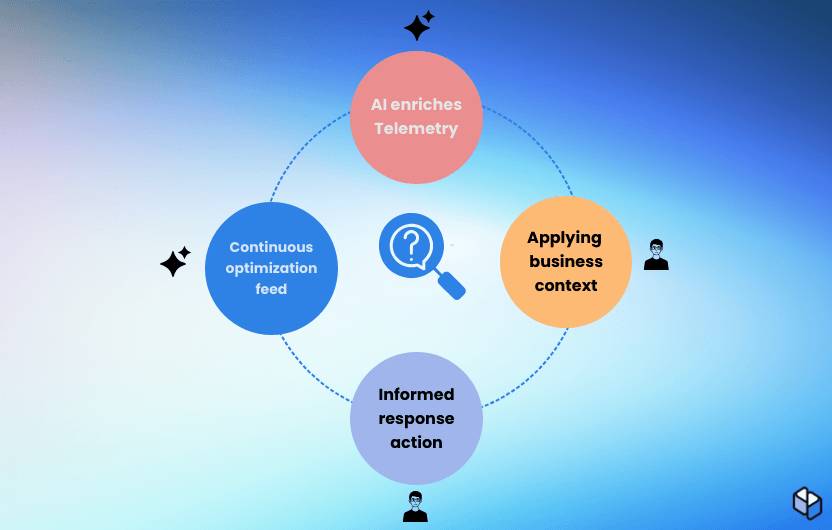
The human-in-the-loop imperative is a design requirement for any security workflow involving automated response. AI excels at pattern recognition and correlation. It has no model for what “normal” looks like in your organization’s specific business cycle, internal dynamics, or risk tolerance. Those judgment calls belong to humans, and security teams that design their AI workflows accordingly are more resilient than those that don’t.
Garbage in, garbage out: the data quality trap
Poor data quality is the cybersecurity AI limitation that gets the least attention in vendor demos and the most attention in post-deployment retrospectives.
Poor data quality shows up in concrete failure modes:
- Cloud workloads without agents are invisible to the model.
- If your SaaS apps aren’t connected to your SIEM, behavioral baselines are built on partial activity, which means OAuth token abuse from a compromised account won’t surface at all.
- Inconsistent field formatting across log sources breaks correlation rules on schema mismatches.
- Identity data that doesn’t sync in real time means a deprovisioned account still looks active in the behavioral model hours later.
These visibility gaps create significant security blind spots across enterprise environments. According to Verizon’s 2026 Data Breach Investigations Report, the human element was present in 62% of breaches: errors, social engineering, and misuse that only surface when behavioral models have complete data to work with. Without full visibility into user activity across every connected system, these human-driven patterns are exactly what falls through the cracks.
Each gap is a blind spot that creates false confidence, as AI gives you a clean summary of everything it can see, with no warning about what’s outside the frame.
When data quality is solid, though, the difference is measurable. The first standardized benchmark for AI-driven identity security showed 80% accuracy across real production environments spanning AWS, Okta, and Google Workspace, but performance varied sharply by platform: AWS hygiene questions hit 94% while Okta-related queries landed closer to 65%. The gap between those numbers is a data quality story, not a model capability story.
Hallucination risk and overconfidence in AI security output
Generative AI in security contexts produces confident, well-formatted, plausible-sounding output. Sometimes that output is wrong, and confidence is the problem.
One form of this overconfidence is structural, rooted in the same data gaps covered above. Our recent research on AI-native asset intelligence found that AI security assistants reasoning directly over fragmented data sources produce unstable rankings: ask for the top five risky assets in the morning and get a different list that afternoon, even when nothing changed in the environment. The instability traces back to the data architecture underneath, not the model’s reasoning capability. It’s also why Sola builds a structured map of your environment first, connecting assets, identities, and relationships across every source before any AI reasoning happens. The model works on validated, organized context, and that foundation is what makes the output stable enough to act on.
Beyond data gaps, there’s a second failure mode: models generating confident output that has no basis in the underlying data at all.
AI hallucination, where a model generates responses not grounded in verified data, shows up in security work in specific ways. A practitioner asking an AI tool to identify the threat actor behind an intrusion might receive a detailed attribution to a named group based on shared code patterns, when that code was publicly available on GitHub and the similarity is coincidental. Microsoft’s MSTIC team has documented how shared tooling across threat actors complicates attribution, and a model trained to pattern-match on code similarity can conflate unrelated campaigns with high apparent confidence.
Remediation guidance is another risk surface. An AI tool describing patching steps for a specific CVE might conflate version numbers, describe mitigation steps that apply to a different but similarly named vulnerability, or recommend configuration changes that are syntactically correct but wrong for the actual environment.
The mitigation is a verification workflow, not a wholesale rejection of AI security tools. AI tools that ground responses in verified, real-time data sources reduce this risk substantially. Requiring human review before any AI-generated guidance is acted on, particularly for incident response and remediation, catches the errors before they compound.
Attackers use AI too: the arms race reality
AI-assisted cyberattacks have risen sharply since 2024, and the majority of phishing emails now lean on AI language models to sound more convincing. The numbers are useful context, not a reason to panic, but understanding the attack surface helps you prioritize where AI defenses actually matter.
According to IBM’s 2025 Cost of a Data Breach Report, 16% of breaches now involve attackers using AI, and organizations with high levels of shadow AI face breach costs of $4.74 million, $670,000 more than those with low or no shadow AI usage.
Attackers are using AI in several ways:
- Personalizing phishing at scale
- Automating reconnaissance across exposed attack surfaces
- Generating malware variants that evade signature-based detection
OpenAI’s threat intelligence reporting has documented state-affiliated actors using AI tools for spear phishing content generation and social engineering script development.
The same AI-driven speed that helps defenders correlate events also helps attackers iterate on evasion techniques faster. Accepting that dynamic is more useful than expecting AI to close the gap permanently.
What this means for security teams evaluating AI tools
AI raises the floor of what a small team can accomplish, but only if the fundamentals underneath it are solid. For security teams evaluating AI security tools, “works out of the box” needs a concrete definition:
- Pre-built integrations with the cloud, identity, and endpoint sources you already use
- Time-to-value measured in days
- No data science team required to tune models or write correlation rules from scratch.
Before buying, ask four questions:
| Evaluation question | Why it matters |
| Does the tool explain its reasoning or merely produce outputs? | Unexplained outputs can’t be verified or trusted in high-stakes decisions |
| How does it handle gaps in log coverage? | Blind spots create false confidence without visible coverage warnings |
| What verification workflows exist for AI-generated recommendations? | Acting on wrong AI output compounds errors before they are caught |
| How is the model updated as your environment changes? | A static model degrades as your infrastructure and threat landscape evolve |
Together, traceability, coverage visibility, human review gates, and continuous retraining separate AI tools that reduce security debt from those that quietly compound it.
Sola’s Lumina Signals is built specifically for this context:a cross-domain intelligence layer that maps assets, identities, and relationships across your connected sources, surfaces explainable findings. It gives smaller teams the cross-domain coverage that would otherwise require multiple specialists, each watching one slice of the environment.
Evaluating AI security tools: questions that matter
Before evaluating any vendor, understand one distinction. Genuine machine learning refines its detection logic over time without manual rule updates; rule-based automation fires the same static signatures until someone rewrites them. Two diagnostic questions expose which one you’re buying: “How does your system update its detection logic?” and “Can you show detection accuracy data over a six-month window?” If answers involve scheduled rule pushes rather than continuous retraining, you’re looking at automation with an AI label.
Now run every vendor through this pass/fail set. A non-answer counts as a fail.
| Question | Pass | Fail signal |
| What data sources must be connected before the AI provides reliable output? | A specific integration list with coverage thresholds | No list means no trained context. Exit. |
| What is your false positive rate on lateral movement detections in hybrid environments? | Specific percentages with documented testing methodology | “Industry-leading accuracy” without proof (that’s numbers). |
| Where do analysts review, approve, or reject AI-driven actions? | A named workflow with human override at every decision point | No override mechanism: walk away |
| How many hours does deployment take for a five-person team with standard cloud infrastructure? | A specific number under 90 days. | No number, or anything above 90 days signals enterprise complexity an SMB team can’t absorb |
| Can you show a detection the AI learned beyond its original rule set? | A documented emergent detection with before/after comparison | Only preconfigured rules, so you’re paying AI prices for traditional automation |
As MIT CSAIL researchers have noted, meaningful AI reliability benchmarks require transparent reporting of both accuracy and failure modes. Hold every vendor to that standard.
What AI in cybersecurity comes down to
Vendors are right that AI changes what a small security team can accomplish. Attackers are right that AI makes their operations faster and harder to catch. And the full picture is that AI amplifies whatever it’s pointed at. Point it at clean data, defined workflows, and human oversight, and you get compressed triage times, behavioral detections no analyst could run manually at scale, and investigation capacity that scales without headcount. Point it at incomplete logs and undefined processes, and you get confident-looking dashboards over blind spots.
AI won’t fix a broken security program, but applied to a functional one, it multiplies what your team can accomplish without multiplying headcount. The teams getting value from AI security tools right now win on fundamentals rather than budget. They connected their data sources properly, kept humans in the decision loop, and picked tools that explained their reasoning.
For your next move: pick one use case where your data is already clean, like alert triage or identity anomaly detection. Require explainability from any tool you evaluate. Keep humans in the response loop for remediation decisions. Finally, skip anything that demands a data infrastructure overhaul before delivering its first useful insight. Sola is built for exactly that starting point: connect your existing sources, get explainable findings from day one, and keep your team in control of every remediation decision.
Key takeaways
- AI’s four real strengths are speed at scale, plain-language queries, behavioral pattern detection, and reduced analyst toil.
- Poor data quality is the biggest hidden failure mode. AI gives a clean summary of only what it can see, and can’t tell you what it’s missing.
- Generative AI produces confident, plausible output that is sometimes wrong. Require human review before acting on remediation guidance.
- Before buying, demand traceability, coverage visibility, human override, and continuous retraining. Treat any non-answer as a fail.
- Begin with one use case where your data is already clean, like alert triage or identity anomaly detection.
AI for cybersecurity starts with the right context.
Get started with Sola.
Frequently asked questions

Cybersecurity, AI and everything in between.
Providing the right context for elite security practitioners. In this particular context, we do it through writing articles and insights.