Cybersecurity AI: How artificial intelligence solves security challenges for teams who can’t afford to waste time

TL;DR
- Most AI security tools target 40-person SOCs, leaving lean teams with noise instead of signal
- Four AI use cases cut real workload for teams of one to ten: alert triage, incident response automation, vulnerability prioritization, and compliance reporting
- The harder problem isn’t another workflow tool, it’s a context layer that reasons across your whole environment, the way every other corner of the enterprise already has
- A phased 90-day rollout beats big-bang deployments because you learn what works before you depend on it
- AI triage alone can reclaim 16+ hours per analyst per week, translating to over $180,000 annually for a 3-person team
- Organizations using AI-driven security operations save an average of $2.2 million in breach costs compared to those without.
How much of your team’s time last week went to work that AI should already be handling?
Most cybersecurity AI solutions were built for programs with a specialist per domain: a dedicated triage analyst, a vuln team, a compliance lead. Running a lean function means inheriting all that complexity without the headcount it assumes.
Attackers run automated campaigns around the clock. The 2025 ISC2 Cybersecurity Workforce Study found 59% of security teams face critical or significant skills shortages, up from 44% a year earlier. We’ll cover four high-impact use cases where AI cuts real workload for teams of one to ten, a 90-day rollout, ROI math grounded in real data, and how to pick tools without torching your yearly budget.
The 4 AI capabilities that actually move the needle for security teams
Security practitioners are hunting for answers first. They’re looking for fast, grounded answers, and automations follow from that. Sola’s analysis of 7,592 real-world security prompts in 2025 found nearly 60% of practitioner queries center on understanding and investigating data, not triggering automated action. Answers, fast and grounded, are the job to build for. The four use cases below target the biggest time-drains in lean operations, and each leans on that same instinct: get a trustworthy answer first, then decide.
- Alert triage that correlates signals across tools, filters noise, and surfaces genuine threats ranked by contextual risk, not raw severity score alone
- Incident response automation that handles evidence collection and containment for solo operators
- Vulnerability prioritization that ranks CVEs by exploitability, asset criticality, and business exposure in your specific environment, not just CVSS score.
- Compliance reporting that maps controls continuously instead of in a pre-audit scramble
Alert triage that actually works
Alert fatigue doubles as a detection problem. When analysts review hundreds of alerts a day manually, noise buries true positives, and the ones that slip through become incidents.
AI triage scores each alert against several variables at once: asset criticality, user behavior baselines, threat intelligence, historical incident patterns, and attack chain context. A low-severity alert on a crown-jewel server (a system holding your most sensitive data or running your most critical business functions) scores differently than the same alert on a test machine. Manual triage either skips that context or takes 20 minutes to rebuild it. Teams running AI-assisted triage typically reduce false positives materially enough that analysts spend time investigating, not triaging.
What if AI misses something critical? Exhausted analysts reviewing their 200th alert miss things too. AI won’t be perfect, but a well-tuned model with defined escalation rules stays more consistent than a fatigued human at 4 p.m. on a Friday.
Sola’s triage runs on cross-domain reasoning, where the AI draws on identity, endpoint, cloud, and network data at once to score each alert. Every score reflects your whole environment, not one layer in isolation. Underneath that behavior sits the part that requires major resources to build: a continuously-updated knowledge graph that maps every asset, identity, and resource in your environment and keeps it accurate as things change. Wiring an LLM to security data is a few weeks of work. Maintaining that graph, and reducing noise so the model reasons over the dozen resources that matter instead of fifty thousand, is the hard part, and it’s why each alert score reflects real relationships rather than isolated signals.
In independent benchmarking across 77 questions from real production environments, Sola’s AI agent reached 80% overall accuracy, up to 94% on AWS hygiene questions, comparable to leading general-purpose enterprise models on structured security reasoning, with the methodology and results published on arXiv so you can check the work yourself.
Triage tells you what matters; incident response determines how fast you can act on it.
Incident response automation for solo operators and small teams
Evidence collection, timeline reconstruction, and impact scoping eat far more time than detection itself. For a solo operator, a single complex incident can swallow the whole week and leave everything else unmonitored. When an endpoint triggers a high-confidence malware classification, automated containment can isolate the host, pull forensic artifacts, notify the owner, and open a structured ticket before the analyst finishes a first review.
The human-in-the-loop distinction matters here. Full automation makes sense for containment actions with low blast radius, like isolating a single endpoint or revoking a compromised token. Broader actions, like blocking a CIDR range or disabling a service account several teams depend on, should stay in human hands with AI-generated recommendations ready to act on. The analyst arrives at the decision with the evidence already assembled, not buried in a queue.
The same speed advantage applies to your vulnerability backlog, which grows faster than any team can clear manually.
Vulnerability prioritization without the backlog
Nearly 49,200 new CVEs landed in 2025, up from 40,700 in 2024, continuing a multi-year streak of record-breaking vulnerability volume. Verizon’s 2025 DBIR found that exploiting vulnerabilities as an initial access vector accounts for 20% of analyzed breaches, which makes prioritization a direct breach risk, not only an efficiency problem. Triaging which ones actually matter before attackers exploit them is where most teams fall behind.
Raw CVSS scores don’t account for your environment. A high CVE on a system with no internet exposure and compensating controls carries less urgency than a medium CVE on an externally facing service with active exploit code in the wild.
AI-driven vulnerability management continuously correlates your asset inventory against new CVE disclosures, checks for active exploitation evidence, and scores findings against your specific environment.
Prioritizing the right CVEs also feeds directly into continuous compliance, which is the next time-drain AI can cut.
Compliance reporting that doesn’t require overtime
Audit preparation is one of the most predictable time drains in security operations: a point-in-time scramble that pulls analysts off active threat work for weeks, reconstructing evidence you should have captured all along. Continuous control mapping removes that scramble. Security events, configuration states, and access logs map automatically to specific controls across compliance frameworks (such as SOC 2 or ISO 27001) as they happen, so you maintain a living audit package that updates daily.
Automated evidence packaging generates what auditors actually need: control narratives, log samples, exception reports, and testing evidence in the framework’s format. Continuous monitoring also surfaces control gaps in real time, so your team is able to tackle issues before an auditor finds them.
The same context that scores your alerts can answer compliance questions too, so a GRC lead isn’t waiting on the SOC analyst to pull evidence by hand. When one layer serves triage, audit prep, and the CISO’s risk questions, a lean team stops paying the tax of reconciling separate tools.
ROI reality check: What AI security actually costs vs. what it saves
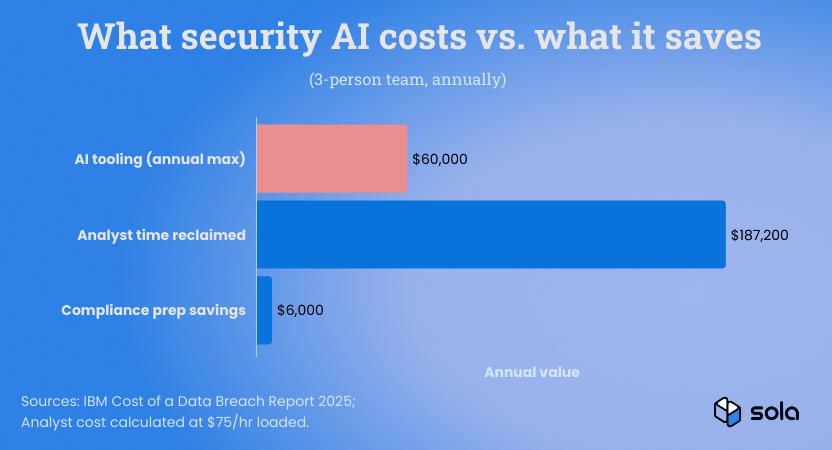
AI security tooling for lean teams typically runs $500 to $5,000 a month depending on data volume and capabilities. The price surprises teams who haven’t budgeted for it, but 58% of SMBs already spent more on cybersecurity in 2024 than they planned, usually after an incident forced it. Free tiers let teams prove value first. A focused deployment takes two to four weeks.
On the savings side: if AI triage cuts manual review from four hours daily to 45 minutes, your team reclaims roughly 16 hours per analyst per week. At a loaded $75 per hour, that’s $1,200 per analyst per week, and over $180,000 a year for a 3-person team.
IBM’s Cost of a Data Breach Report 2025 found organizations using extensive AI and automation in security operations saw an average of $2.2 million lower breach costs than those that did not. AI adoption cut the global average for the first time in five years, yet U.S. organizations still hit a record $10.22 million average in 2025.
Compliance adds another layer. Teams spending 80 hours preparing SOC 2 evidence by hand can cut that to 20-30 hours with automation, saving $4,000 to $8,000 per audit cycle.
Analysts who manage sustainable workloads stay longer, develop faster, and take on higher-value work, so retention gains alone often outweigh tooling costs.
Implementation roadmap: From zero to AI-augmented in 90 days
A phased approach beats a big-bang deployment: you learn what works in your specific environment before building operations that depend on it. The goal at day 90 is a stable, measurable AI-augmented baseline.
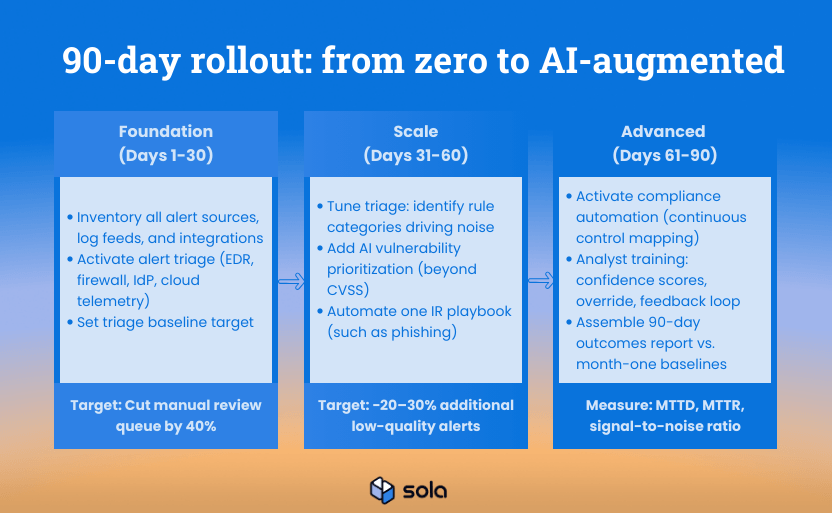
Days 1-30: Foundations and quick wins
- Start with an honest inventory: every tool generating alerts, the log sources feeding your SIEM, and the integrations you actually have versus the ones that were “planned.”
- Activate one use case first, and alert triage is in many cases the right choice. Connect your primary log sources: EDR telemetry, firewall logs, identity provider events, and cloud workload telemetry cover most of the meaningful detection surface for a lean team.
- Set a concrete target: cut the manual review queue by 40% while improving the quality of what remains, or drop average triage time from 15 minutes to under 5. Both are achievable in 30 days. Run a short team orientation on how the scoring model works and where its limits sit.
Days 31-60: Scaling what works
- Pull the false positive rate from your triage layer and find the rule categories producing the most noise. Tuning those in week five typically cuts another 20-30% of low-quality alerts.
- With triage stable, add vulnerability prioritization. Run your first AI-assisted pass against your CVE backlog, factoring in asset criticality, active exploitability, and exposure rather than CVSS alone, and set a remediation velocity baseline.
- Then automate one incident response playbook during month two. Pick something high-frequency and lower-complexity, like phishing triage or malware quarantine, and document before-and-after time-to-contain.
Days 61-90: Advanced capabilities and team training
- Activate compliance automation last. It benefits from a running start: 30 days of continuous control mapping adds value before an audit, and six months is better.
- Run formal training on how analysts should interpret confidence scores, when to override recommendations, and how to give feedback that improves the model.
- At day 85, assemble a 90-day outcomes report for leadership. Compare MTTD, MTTR, signal-to-noise ratio, and compliance readiness against month-one baselines, and translate analyst hours reclaimed into dollars using fully loaded salary costs.
Tool selection: AI security platforms that won’t burn through your entire budget
Specific product comparisons go stale fast, especially in a category moving so quickly such as cybersecurity, so evaluate by category and criteria that matter to a 2-10 person team, and not only by analyst rankings built for enterprise buyers.
The main platform categories:
- AI-native SIEM platforms offer broad detection coverage but carry configuration complexity and ingestion costs that scale quickly.
- SOAR-lite platforms focus on playbook automation and suit teams that already have detection coverage.
- Vulnerability management platforms with AI scoring address prioritization but don’t replace detection or cross-domain context.
- AI security copilots provide the analyst assistance layer.
There’s a fifth category that doesn’t slot into the tiers above: security intelligence infrastructure. Instead of competing on detection or playbooks, it sits across your existing tools and answers questions about your whole environment, the layer the other four were never built to provide.
Detection is commoditizing. The underlying models are converging, and “we detect threats” is table stakes now. The scarce asset is context, a maintained understanding of your specific environment that makes an AI answer trustworthy rather than plausible-sounding.
A context layer that reasons across identity, cloud, SaaS, and code addresses something none of the single-domain categories can, and it spares you the integration tax and per-data-volume cost surprises of stitching point tools together.
Rank your evaluation criteria by practical importance:
- Integration breadth with your stack
- Pricing transparency at your data volume
- Ease of configuration without professional services
- Support quality for small teams
- Explainability of AI scoring
Questions worth asking vendors directly:
- How do you use customer data to train shared models?
- Where does data reside?
- What’s the timeline without a paid onboarding package?
- What happens when the model produces a significant false negative?
- How does the platform fold asset criticality and business context into its risk scoring?
Red flags:
- Demos that show only clean, pre-staged environments
- Pricing that needs a custom quote for any real configuration
- AI features that amount to filtered search or severity re-sorting
- Vague answers on data residency
Cybersecurity spending keeps rising, so transparent pricing and clear product scope matter more than ever.
For teams evaluating an AI security platform built for lean operations, Sola on Demand’s platform page walks through the capabilities, integrations, and pricing without a sales call. Sola combines detection coverage, contextual risk prioritization, and analyst intelligence in one platform, so you skip the integration overhead and per-data-volume cost surprises of stitching point tools together.
Common pitfalls and how to avoid them
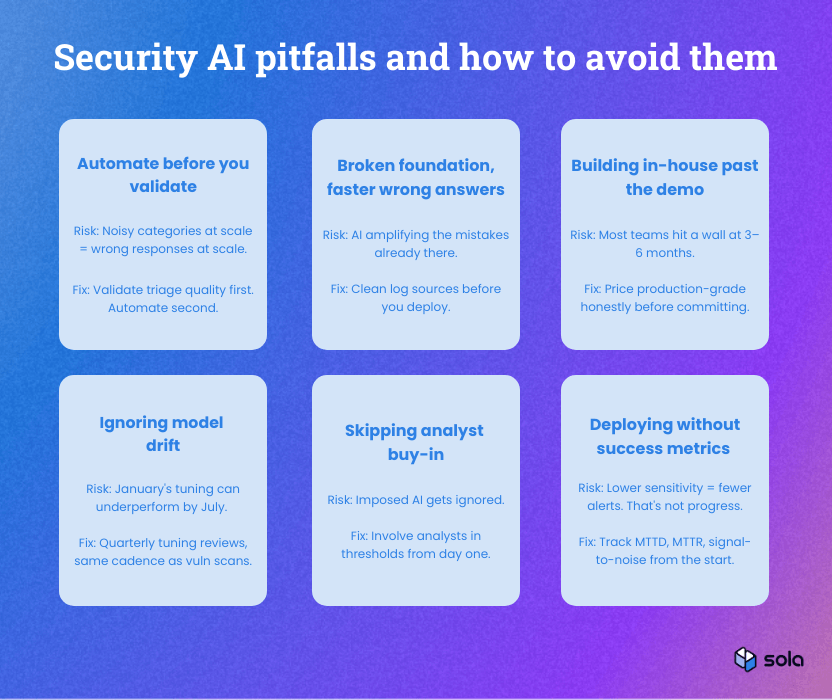
The most expensive mistake is over-automating before validating detection logic. Automating a high false-positive category means automating the wrong response at scale. Spend month one on triage quality before month two on response automation.
AI doesn’t fix a detection strategy that’s missing log sources or running on outdated rules. It amplifies what’s already there, so a broken foundation produces faster wrong answers. The reverse holds too: a clean detection foundation gives compounding returns.
One more trap shows up before you ever pick a vendor: building it yourself. Roughly 80% of security teams are choosing to build AI in-house rather than buy it, and most hit a wall between three and six months. You get a working demo, then a brittle system you can’t trust in production once the environment keeps changing underneath it. The gap between that demo and production-grade, trustworthy intelligence is the whole job, and it’s worth pricing honestly before you commit engineering quarters to it.
Model drift deserves more attention than it gets. A model tuned in January can perform worse by July if your infrastructure changes, adversary TTPs shift, or your alert traffic evolves. Schedule quarterly tuning reviews like you schedule vulnerability scans.
Analyst buy-in matters before deployment. Analysts who feel AI got imposed on them ignore its outputs. Involve them in threshold-setting during month one, and add a lightweight feedback loop where they flag recommendations as accurate, inaccurate, or needing context.
Vendor lock-in surfaces 18 months in. Before signing, confirm you can export detection rules in standard formats like Sigma, plus incident history and enrichment logic, so you never depend on a proprietary schema for your own data.
Deploying without success metrics is the quietest failure mode. If you can’t measure what changed, you can’t justify renewal. Watch one related trap: reducing raw alert count is easy if you lower detection sensitivity. Improving signal-to-noise, MTTD, and MTTR while maintaining coverage is the only progress worth reporting.
One more pitfall: overconfidence in coverage. AI triage improves efficiency against threats your detections already surface. It doesn’t compensate for detection gaps. A platform scoring alerts you’re not generating isn’t protecting you from attacks that generate no alerts at all. Keep running periodic red team exercises or gap assessments against current threat intel.
Measuring success: KPIs that matter for AI-augmented security teams
Six metrics cover the full operational picture and hold up in front of finance, leadership, and board-level security committees.
Mean time to detect (MTTD) measures the gap between when a threat occurs and when your team spots it. AI should move it from hours to minutes for high-confidence categories.
Mean time to respond (MTTR) measures the gap between detection and containment. Automated playbooks should show clear gains within 60 days.
False positive rate tracks the share of AI-scored alerts that turn out benign. A well-tuned system should drop below 20% within 90 days, though behavioral analytics will trend higher than known-bad IOC matching, so track it per rule class rather than as a single aggregate.
Alert-to-investigation ratio measures how many alerts result in a formal investigation. Higher ratios mean better signal quality, not just compressed volume from suppressed detection sensitivity.
Vulnerability remediation velocity tracks how many prioritized CVEs your team remediates or formally risk-accepts per week. Track those two separately, since they tell different stories about capacity and risk tolerance.
Analyst hours reclaimed per week is the most persuasive metric for leadership. Frame those hours as reinvested capacity, like threat hunting or detection engineering, not pure efficiency savings. A leadership audience that sees hours reclaimed without a reinvestment narrative may draw the wrong conclusion about headcount.
Report these monthly for the first year, then quarterly. Track every metric against your own baseline, because your environment and team composition determine what “good” looks like. One metric is absent: detection coverage breadth, so pair these with a periodic coverage assessment mapped against MITRE ATT&CK or current threat intel for your sector.
The future of AI for security teams (and what it means for your career)
Over the next two to three years, AI in security points toward agentic workflows that run with minimal human initiation. Instead of waiting for an analyst to start a query, agentic systems monitor, correlate, and act on defined conditions continuously. For Sola users that direction isn’t hypothetical. Lumina Signals already runs this way, which is why a two-person function can cover ground like a much larger one. The shift over the next few years is less about inventing the capability, and more about how much of your operation you choose to hand it.
Analysts who learn to configure, tune, and interpret AI systems will own the highest-impact roles in security. The skill centers on knowing which questions to ask your AI layer, how to validate its outputs, and when to override it.
The through-line here is simple. The teams that move fastest don’t deploy the most AI features. They build a clean detection foundation, measure what matters, sidestep the automation traps, and develop the judgment to use AI as a force multiplier. We built Sola for the next phase of lean security operations. With Sola On Demand, teams connect their data sources, prompt in plain language, and go from question to custom security project in minutes, with no engineering queue in the way. To see it against your own environment, give it a try with Sola.
Key takeaways
- Alert fatigue is a detection problem. AI triage scores each alert against asset criticality, behavior baselines, and threat intelligence simultaneously, cutting false positives and surfacing real threats faster.
- Detection is commoditizing. The scarce asset is a maintained context layer that reasons across identity, cloud, SaaS, and code. A context layer, based around your data, is what makes AI answers reliable instead of plausible-sounding.
- Automate low-blast-radius actions first: endpoint isolation and token revocation. Keep broader actions, like blocking a CIDR range, in human hands with AI-generated recommendations ready to act on.
- Raw CVSS scores ignore your environment. AI vulnerability management factors in asset exposure, compensating controls, and active exploit evidence, so you patch what actually matters first.
- Continuous control mapping keeps an audit package updated daily, cutting SOC 2 prep from 80 hours to 20-30 hours and saving $4,000-$8,000 per audit cycle.
- Over-automating before validating detection logic is the most expensive implementation mistake. Validate triage quality in month one before building response automation in month two.
- Track six KPIs from day one: MTTD, MTTR, false positive rate, alert-to-investigation ratio, vulnerability remediation velocity, and analyst hours reclaimed per week.
AI for cybersecurity starts with the right context.
Get started with Sola.
Frequently asked questions

Cybersecurity, AI and everything in between.
Providing the right context for elite security practitioners. In this particular context, we do it through writing articles and insights.