Continuous risk prioritization: keeping pace with engineering

TL;DR
- Security teams are working risk queues that were built on a read of the environment that aged out before anyone acted on it.
- Severity scores decay the moment they’re assigned, because the context around a finding changes as engineering ships.
- Risk moves in both directions: a finding that was critical on Monday may be noise by Thursday. A medium that nobody flagged may be your highest-exposure asset by Wednesday afternoon.
- Faster triage and bigger teams won’t close the gap. Adopting agile security requires a scoring model that recalculates against the current environment state on a daily cadence, with severity that moves up and down automatically.
Security teams have always worked from queues, but in recent years they faced an additional question when managing the queue: does it reflect the environment as it is today, or the environment as it was when someone last ran a scan? For most teams, it’s the second one.
Continuous risk prioritization is an operating model, not just a theoretical principle or a product feature. This piece explores how it fundamentally changes the unit of work your security team runs on.
If your severity scores don’t move after they’re assigned, you’re working on last week’s risk picture, and this article illustrates how adopting an agile security framework can help with prioritizing risk continuously.
AI gave every team a speed multiplier. Security inherited the bill
Every function in the org got a velocity upgrade in the last two years. Engineering ships more, product iterates faster, ops spins infrastructure up and down between standups. The security team got the same number of hours in the week, and a queue that grows faster than anyone can work it.
Engineering’s unit of work compressed from quarterly release to daily commit, and that compression rippled into every system engineering touches. Cloud accounts, identity providers, SaaS integrations, and code repos all change at commit speed now. An average environment can ship more new attack surfaces in a sprint than it used to ship in a quarter.
Security’s response model didn’t compress with it. Triage runs on a weekly cycle in most teams, monthly in others. Findings get queued, ranked once at discovery, and worked top-down until someone calls the next review. The cadence was reasonable when environments turned over slowly. It stopped being reasonable when engineering started shipping production changes between lunch and the 3pm standup.
So the gap that matters now is a timing gap. A two-person team working last Thursday’s queue on Tuesday is not behind because they’re slow. They’re working on a document that describes a company that no longer exists.
Everything that follows is about closing that gap, and what the operating model looks like when you do.
The shelf life of a severity score
Every severity score in production has an unstated expiration date. The number reflects the environment at the moment of discovery: which assets the finding touched, what they were connected to, who could reach them, what compensating controls sat in front. Change any of those inputs and the score’s accuracy starts decaying, and most scoring models don’t account for any of that.
Tenable’s exposure research found that only about 3% of findings represent actively exploitable risk in a given environment at any given time. The hard part is knowing which three percent, and that set shifts as the environment shifts. Static scoring can’t tell you which findings are in it today.
A severity score without temporal awareness ages in place. The dashboard shows it as current. The reasoning underneath is from two weeks ago. Continuous risk prioritization starts from a simpler premise: scoring has to be a function of the current environment, recalculated against current state, or it isn’t scoring at all.
The more interesting question is how fast that decay can happen, and what it costs when nobody notices.
Monday’s medium is Friday’s incident
Take a database that starts the week as a quiet medium in the backlog. It’s a dev instance, isolated, with a misconfigured access policy that nobody loves but nobody is rushing to fix. The scoring engine logged it as a 5.4, and the team has bigger things to worry about.
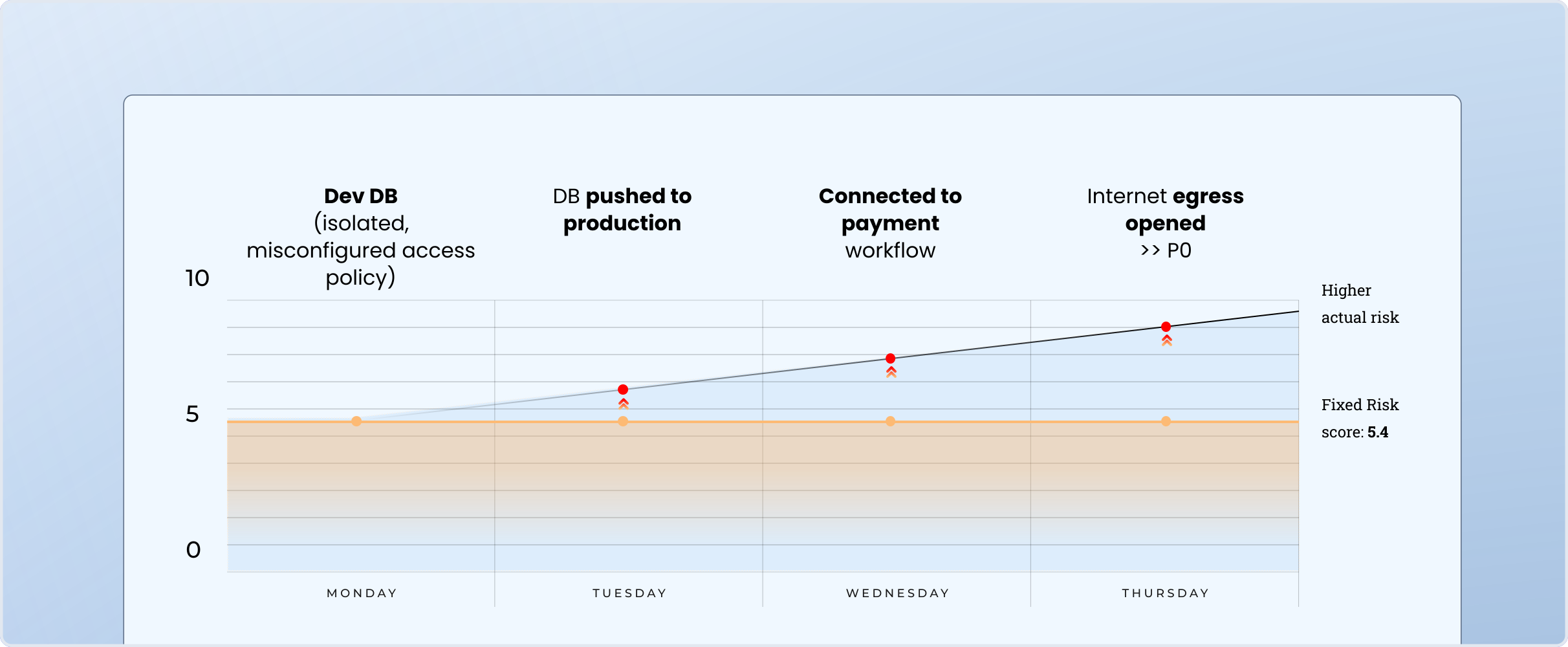
Tuesday, a release promotes the instance to production to support a new feature. The misconfiguration travels with it. No new finding fires, because the finding was already there. The score stays at 5.4.
Wednesday, a developer wires the new production instance into a payment processing workflow. The database now holds transactional data. Still no new alert. The original finding still reads as a medium.
Thursday, an infrastructure change opens a security group rule that gives the database egress to the internet. The misconfigured access policy is now sitting on an internet-reachable asset that touches payments. By any sensible scoring model, it’s a P0. The queue still says 5.4.
Friday morning, a security engineer opens the dashboard. The criticals at the top of the queue are the same ones from Monday, because that’s when they were scored. The actual highest-risk asset in the environment is sitting fourteen rows down, marked medium, with no indicator that anything about it changed.
The finding itself didn’t change. The context around it did. Same misconfiguration, same finding, completely different risk profile. The scoring model couldn’t see any of it because the scoring model only looked once.
The questions the next two sections take on: what would it take to catch this on Wednesday instead of Friday, and what about the inverse case, where the queue is full of findings that stopped mattering days ago.
Deprioritization: the part nobody built
Risk moves down as well as up, and most security tooling only models the up direction. Findings escalate when something gets exposed, but they rarely drop when something gets remediated, deprecated, or covered by a control. The criticals at the top stay critical even after the conditions that made them critical have changed.
Run through the common cases where a finding’s real risk legitimately drops. An asset gets deprecated and taken offline. A compensating control goes into production, like a WAF rule or a network segmentation change. A risk exception gets formally documented and accepted by the business. The asset gets moved behind an identity boundary that wasn’t there before. In every one of those cases, the finding is still technically open in the scanner, but its risk profile in the actual environment has changed.
A scoring model that doesn’t recognize any of that forces the security team to do the recognition manually. Someone has to remember that the asset got deprecated last sprint. Someone has to flag that the new WAF rule covers the finding at row 47. That judgment work is the part of the job that doesn’t scale, and it’s also the part that gets cut first when the team is heads-down on the actual criticals.
The result is a queue that mixes live risk with dead weight, and a team that loses time sorting between them. Risk reprioritization that only escalates is half a system.
What the team needs is a model where the score reflects changes in both directions: up when context makes a finding more dangerous, down when context makes it less. The next section is what that operating model looks like when it works.
Adopting agile security as an operating model
Engineering hit a similar problem well over a decade ago and answered it with continuous delivery: shorter cycles, smaller units of work, the build pipeline as the source of truth. Security’s analog is a daily risk picture that reflects the current state, with severity that moves both directions based on what changed in the environment overnight.
The architecture has three requirements. The platform has to see the full environment, and the connections between them, because risk lives in the connections more than in any single finding. It has to recalculate the score against the current state on a daily cadence. And it has to surface what changed since yesterday, so the security team can work the delta instead of re-reading the full queue every morning.
Lumina Signals is built on that operating model. Severity moves up when context makes a finding more dangerous, and down when context makes it less, against an asset graph that refreshes daily. The team works a queue that reflects actual, current risk.
What the model unlocks is straightforward: the team stops working on last week’s queue. The question about whether yesterday’s deployment opened a new exposure gets answered the day after, not the week after. The findings that stopped mattering get out of the way of the findings that started mattering. Continuous risk prioritization stops being a goal and starts being how the calendar actually runs.
The last question is what changes in the day-to-day when the operating model is real.
Key takeaways: when the calendar matches the environment
The day-to-day shift is smaller than it sounds and larger than it looks. The security engineer still opens a queue every morning. The queue still has criticals at the top. What’s different is that those criticals reflect what’s true today, not what was scored last week.
Key takeaways
- Findings that stopped being load-bearing drop out of the way automatically, without anyone having to remember why.
- New exposures from yesterday’s release surface the next morning, not at the next scheduled review.
- The medium that quietly became your highest-exposure asset overnight shows up at the top, with a marker showing what changed.
- Context determines urgency. The same misconfiguration sitting on an isolated dev instance and on an internet-reachable payment database are two completely different problems, even if the finding ID is identical.
The timing gap that opened when engineering started shipping daily is closeable. The operating model just has to catch up.
See which findings actually matter today.
Frequently asked questions

Senior Product Manager, Sola Security
Or brings a decade of product experience across cybersecurity startups, including an early role at a company that grew from zero to acquisition. At Sola, she takes the complexity out of how security teams understand and act on risk, one well-scoped product decision at a time.